

I Built an AI System That Thinks Through Startup Ideas With Me (In just a day)
Come build production-grade AI workflows and practical agents with me.


Welcome to the 46th issue of AI Agents Simplified 🍻
This issue is brought to you by Entail AI

Last issue was about why I stopped building before validating.
This is the next step: I stopped doing validation manually altogether. I turned the whole process into an agent.
The problem I couldn’t ignore
Every time I had a new idea, for example my recent concept for an AI-driven language platform for US-based professionals, the workflow was the same:
Search competitors (Duolingo, ELSA, Cambly).
Read user complaints across Reddit.
Sketch a lean canvas.
Guess if it’s worth building.
It worked, but it didn’t scale. I wasn’t short on ideas; I was short on the hours required to dismantle them properly. So, I built an engine to do it for me.
The Idea
An agent that takes a raw idea and turns it into structured decision material:
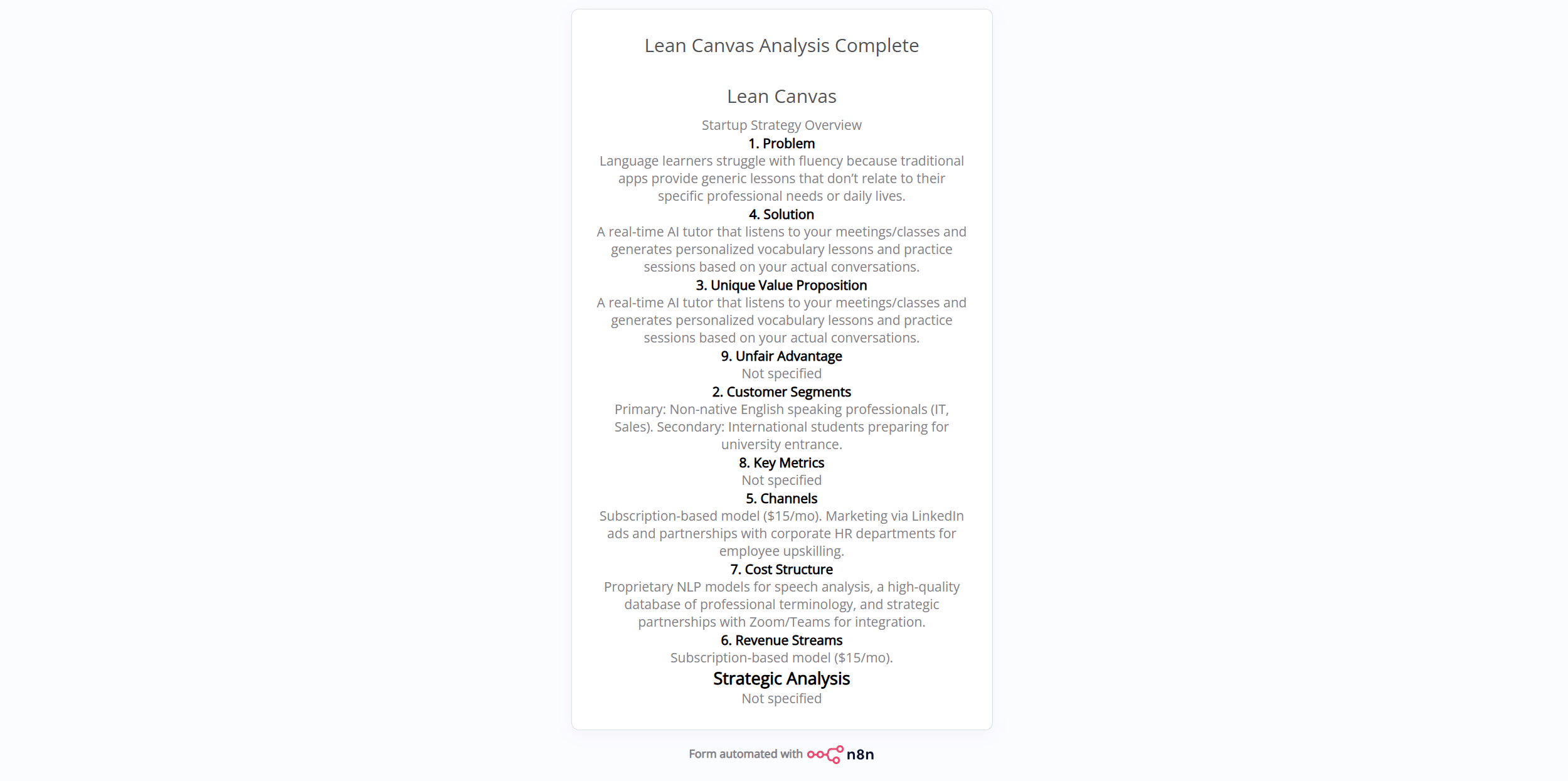
Lean Canvas (The strategy)
Competitor Analysis (The market reality)
Structured CSV Output (The operational data)
No spreadsheets. No scattered docs. Just input → structured output.
A multi-step n8n workflow that connects GPT to logic, forms, and data exports.
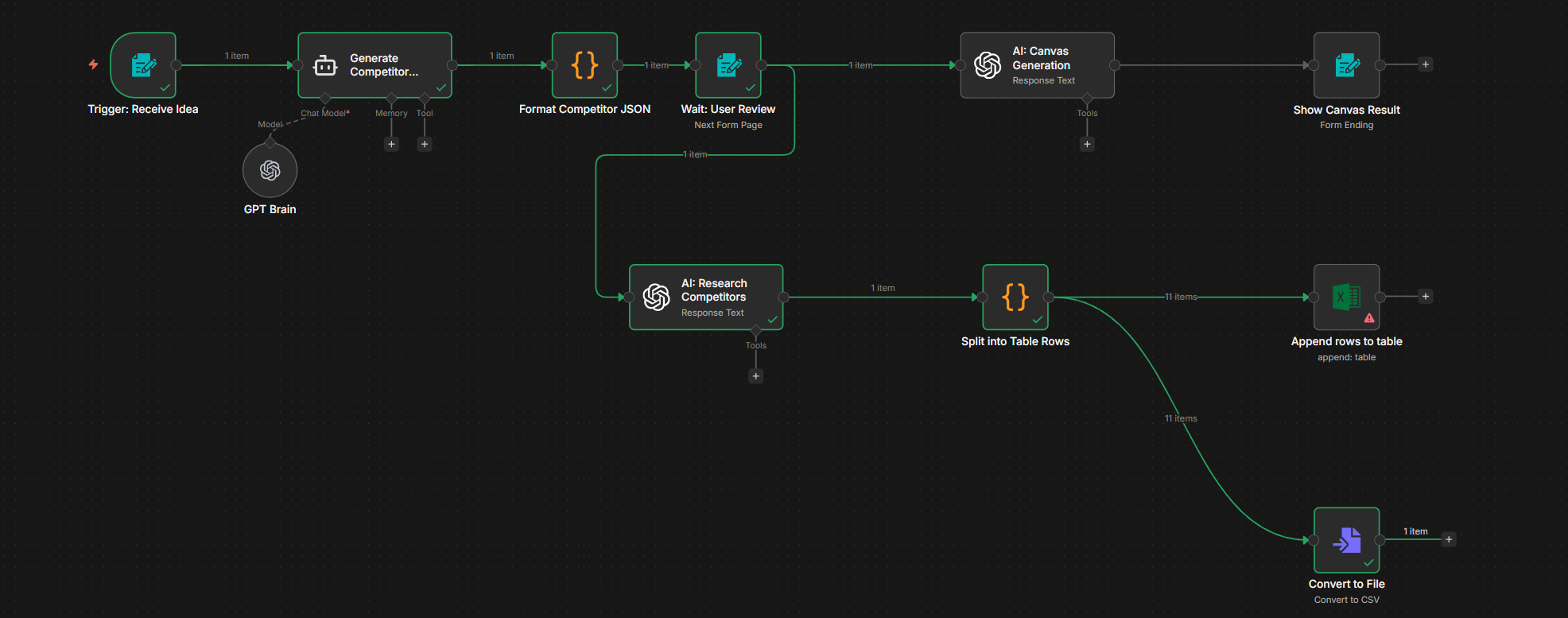
How the system works
1. Idea intake
Everything starts with a single input: the description, business type, and target country. For this test, I used: “An AI that integrates with Zoom to teach English to Persian speakers based on their real-time meeting mistakes.”
2. Forcing clarity before research
Before any analysis happens, the agent breaks the idea down and generates 5 focused questions. This is where most ideas fail, silently. It forces me to define the “Unfair Advantage” before the “Brain” starts working.
The interrogation phase. The agent forces me to answer the hard questions before it spends a single token on research.
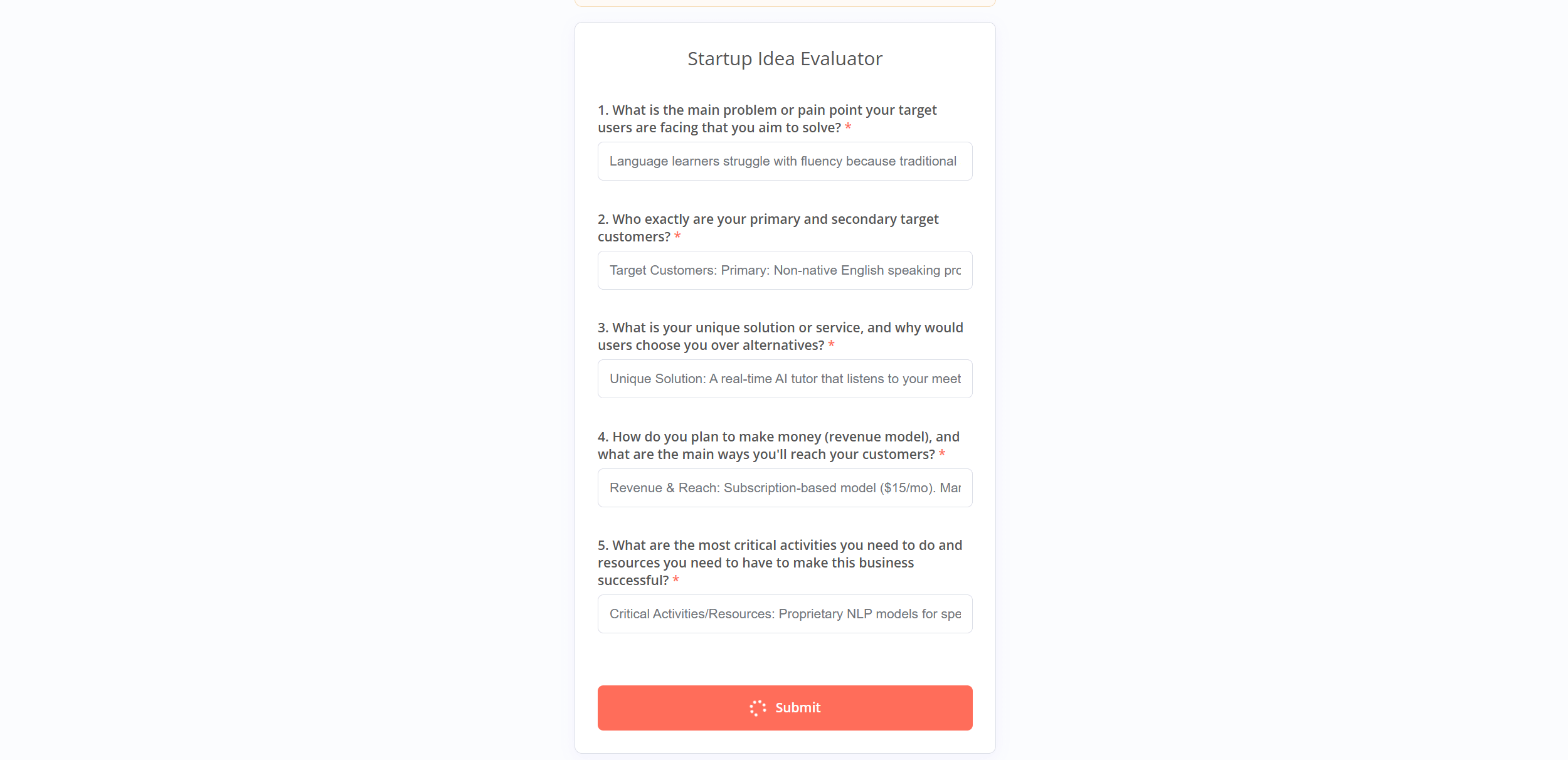
These questions are designed to gather deeper context about:
the customer
the problem
differentiation
pricing
existing alternatives
The questions are displayed inside an n8n Form node and once the user answers them, the responses are structured and prepared for the next stage of the workflow.
3. Then the data gets passed to 2 separate AI agents running in parallel.
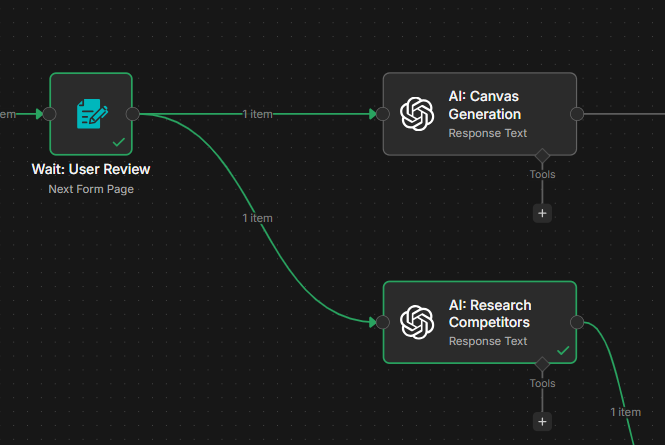
The first AI focuses on generating a Lean Canvas.
It instantly analyzes the data to map out the core problem and solution for our target customer segments,
defines our unique value proposition, acquisition channels, and critical key metrics,
while laying out the underlying revenue streams, cost structure, and our ultimate unfair advantage.
The second AI focuses on researching the market landscape, analyzing competitors, and identifying gaps and opportunities to validate the startup idea.
It instantly benchmarks my idea against 3 to 5 real-world competitors,
generating a strategic feature matrix that scores our offering against the market giants across 10 key performance domains,
while providing expert-level, actionable commentary on where we can exploit their weaknesses and dominate.
Give Your AI Agent Eyes on the Web

MCP servers eat 72% of your agent’s context window before it reads a single user message. There’s a simpler way.
Bright Data CLI gives coding agents like Claude Code, Cursor, and Copilot direct access to real-time web data - from the terminal. No MCP schema bloat. No server setup. Just one command:
brightdata scrape https://any-website.com → structured JSON
Scrape any URL with automatic CAPTCHA bypass. Search Google/Bing/Yandex. Extract structured data from 40+ platforms (Amazon, LinkedIn, Instagram, TikTok, YouTube, Reddit, and more).
One install. Works with 46+ AI agents. 10-32x cheaper than MCP for the same tasks.
The Results
Once both AI agents finish their analysis, the workflow automatically compiles the output into structured, decision-ready artifacts.
Instead of spending hours jumping between Reddit threads, competitor websites, spreadsheets, and scattered notes, the system delivers a complete strategic breakdown in minutes.
Lean Canvas:
Competitor Analysis:

Turning Validation Into a System
This project changed how I approach startups entirely.
Instead of jumping from idea to building, I built a system that forces every idea through structured validation first, competitor research, strategic analysis, and market positioning included.
What used to take hours of manual work now happens automatically through a multi-agent workflow designed to answer one question:
Is this idea actually worth building?
Question:
If you could automate one painful part of building startups, what would it be?
I’d genuinely love to hear your thoughts and opinions in the comments.
Hi,
Love your content on AI Agents! I'm Sia from Novita AI—we help developers access and deploy LLMs instantly, without the hassle of managing infrastructure themselves.
We're currently building our creator network through an affiliate program. Your followers are exactly the kind of developers and builders who benefit from our service, and I think this could be a valuable opportunity for you.
Happy to share details if you're interested.
Best,
Sia
Startup pain point that takes time is setting up social channels and making sure all is set correctly and tied back to a management hub. Doesn’t take that long, but it is tedious. Be nice to have an automated workflow because everybody has to set up Facebook, Insta TikTok, X LinkedIn and others but if there was a way that could be automated just by handing logo in pertinent information sure would’ve been nice this morning when I was fighting with Instagram and making sure I wasn’t setting up a totally new account. It was tied back to my main Meta account. It’s just one of those things nobody does a lot of repetitively once it’s done it’s done so there was an automated workflow that could be created
that would be awesome.