

Stop Building Blind: How I Validate Product Ideas with AI Agents
My workflow for using AI agents to research markets, analyze competitors, and validate product ideas before building.


Welcome to the 43th issue of AI Agents Simplified 🍻
This issue is brought to you by MarketBeat

Most product failures don’t happen because teams can’t build, they happen because they build the wrong thing.
Why I Always Evaluate Ideas Before Building 🧠
One of the most expensive mistakes in product development is building before validating.
I’ve seen teams jump straight into design, engineering, and launch, only to realize later that the market doesn’t actually need the product, or that a stronger solution already exists.
Before committing resources, I try to turn assumptions into evidence.
Validating ideas early helps me:
Reduce product risk
Avoid wasting engineering time
Discover real customer problems
Understand the competitive landscape
Improve the chances of product‑market fit
The mindset shift is simple:
Instead of asking “Can we build this?”
I try to answer “Should we build this?”
That small shift can save months of work.
What I Do to Evaluate a Product Idea 🚨
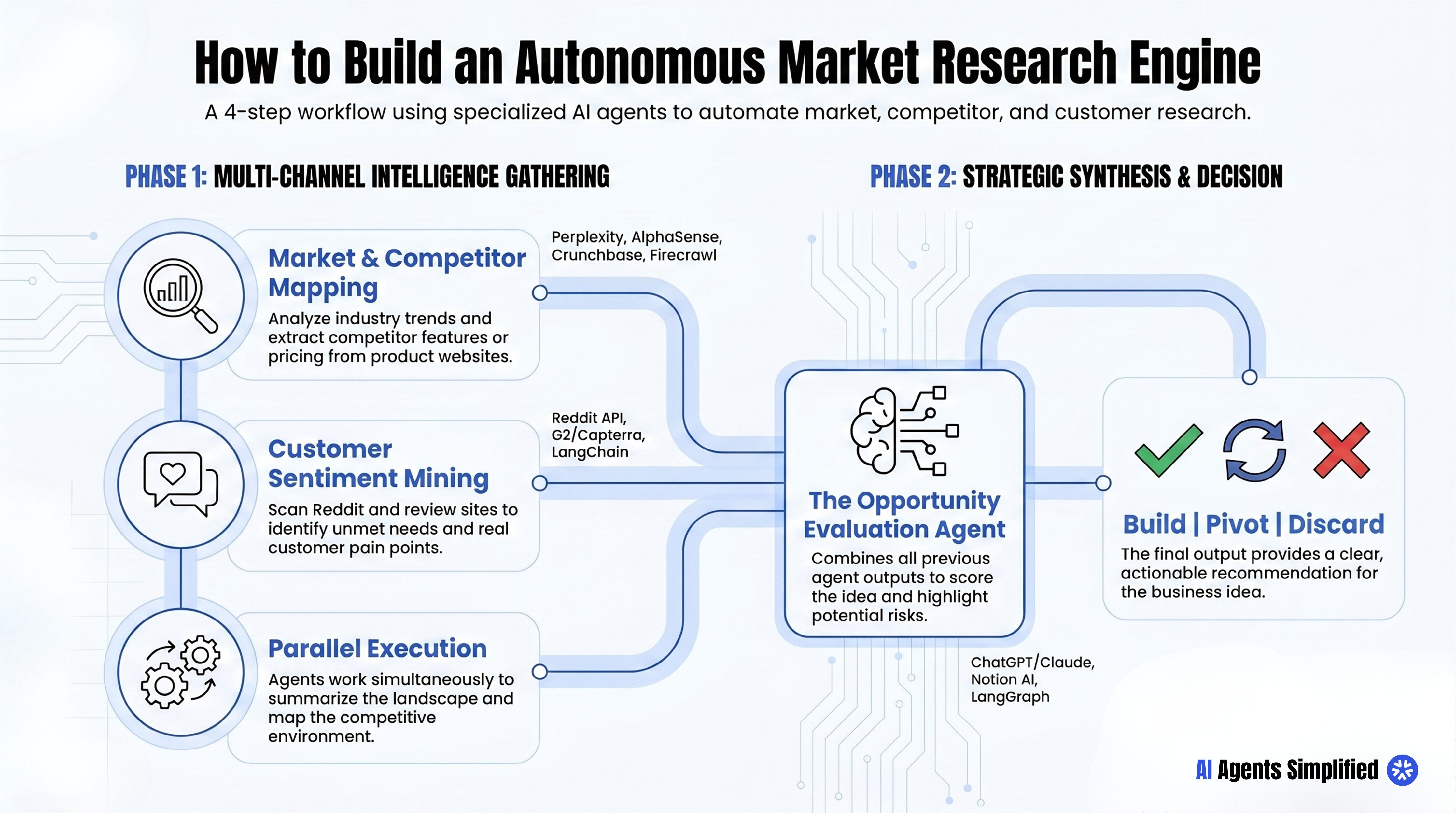
When I’m evaluating a new idea, I usually focus on four areas.
1. Market Understanding
First, I try to understand the problem space.
I look for who has the problem, how serious it is, how people solve it today, and whether the market is growing.
This usually involves quick market research, trend analysis, and scanning industry reports.
2. Competitor Analysis
Next, I map the existing solutions.
I identify direct competitors, indirect competitors, and substitute tools. Then I quickly review their features, pricing, positioning, and user feedback.
The key question I want answered is simple:
Is there still room for a better product here?
3. Customer Research
Then I try to understand the actual user pain.
Sometimes that means interviews or surveys. But very often I analyze discussions and reviews across places like Reddit, X, forums, and product review sites.
This helps me spot recurring complaints, unmet needs, and feature gaps.
4. Opportunity Evaluation
Finally, I combine everything.
I estimate market size, think about differentiation, evaluate timing, and assess whether the idea could realistically become a viable product.
At the end, I usually summarize the idea in a short validation brief or scorecard.
The Problem With Doing This Manually ⚙️
The challenge is that this work takes a lot of time.
Evaluating even one idea can involve:
hours of competitor research
reading dozens of sources
scanning discussions across multiple platforms
synthesizing large amounts of information
As a product manager, doing this manually can quickly become a bottleneck.
You either spend days researching—or you skip the process and rely on intuition.
Neither option is great.
The Next Wave of Market Leaders

Every market cycle creates a small group of stocks that end up doing most of the work.
The surprise is not that they succeeded - it’s how early their trajectory was visible.
The next group of leaders is already taking shape, just outside the spotlight.
FREE Report highlights 7 companies with expanding cash flows, growing market share, and the characteristics that often precede long-term leadership.
❤️ The best way to keep our mission going - at zero cost to you - is by checking out this free guide from our sponsor.
How I Use AI Agents to Automate This Process 🤖
Recently I started using AI agents to automate much of this research.
Instead of doing everything myself, I set up a few specialized agents that each focus on a specific task.
It feels like having a small research team working in parallel.
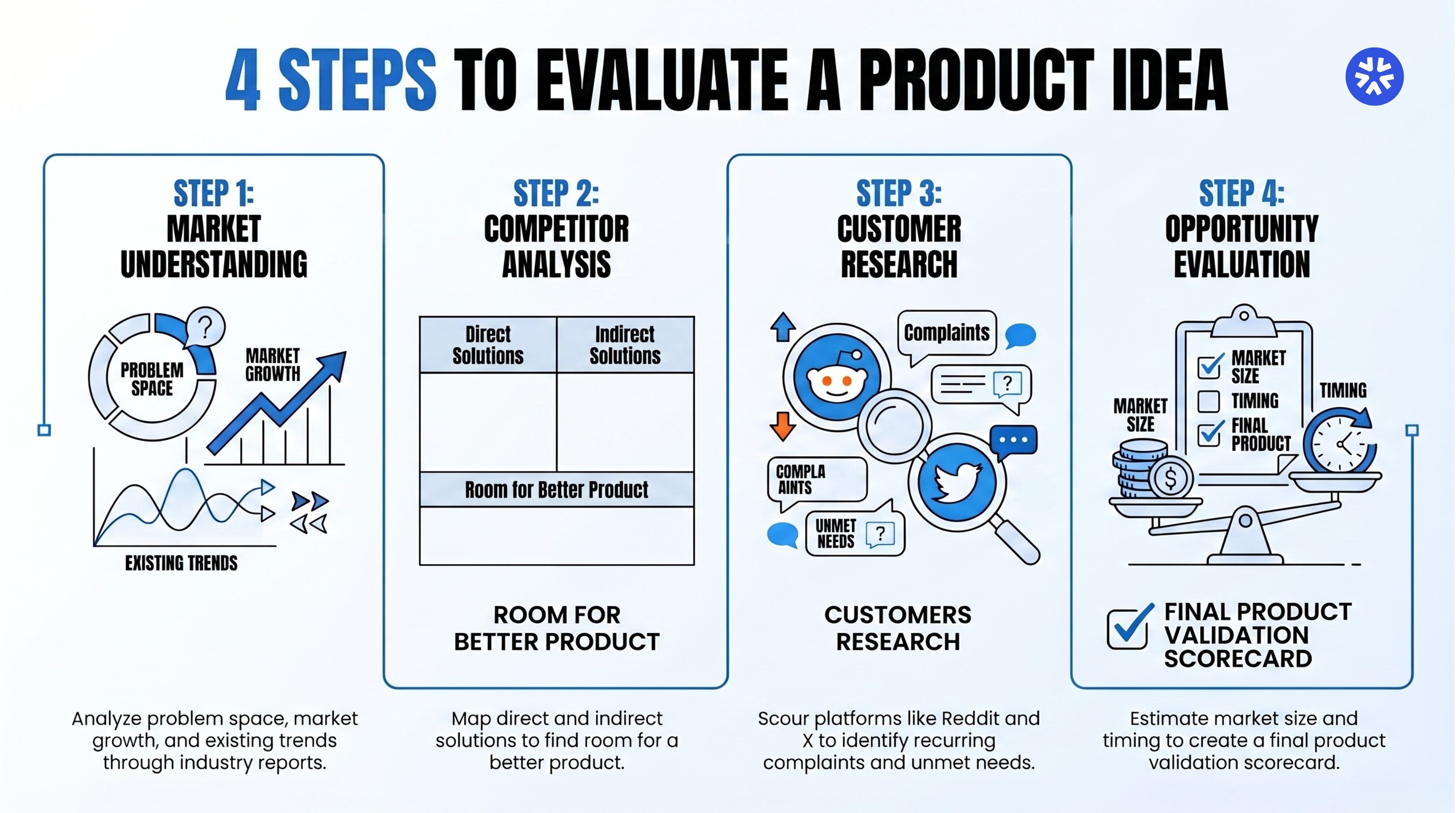
Market Research Agent
Tasks:
This agent explores the market and summarizes the landscape. I use this agent to scan industry reports, surface key trends, estimate how big the market really is, and outline where the strongest opportunities exist.
Output: a short market overview with key insights.
Tools I use:
Perplexity Deep Research
ChatGPT Deep Research
AlphaSense for industry data
Competitor Intelligence Agent
Tasks:
This agent maps the competitive landscape.
It finds competitors, breaks down their features and pricing, and evaluates how each product is positioned.
Output: a structured competitor analysis.
Tools I use:
Perplexity for competitor discovery
SimilarWeb for traffic insights
Crunchbase or PitchBook for company data
Firecrawl or Browserbase for website crawling
Customer Insight Agent
This agent analyzes what users are actually saying online.
Tasks:
This agent scans Reddit, X, and other communities to understand what users are actually talking about. It reviews product feedback, highlights common complaints and feature requests, and uncovers unmet needs across the market.
Output: a list of real customer pain points.
Tools I use:
Common Room for community insights
LangChain pipelines for extracting insights
Opportunity Evaluation Agent
Finally, I use an agent to synthesize everything.
Tasks:
I rely on this agent to pull every insight into one place, market data, competitor findings, customer pain points and turn it into a clear evaluation. It scores the idea, points out the risks, and offers practical ways the product could differentiate.
Output: a simple build → pivot → discard recommendation.
Tools I use:
Notion AI or Airtable AI for scoring frameworks
LangGraph workflows for orchestration
OpenAI Assistants or AutoGen for multi‑agent reasoning
Revealed: Today’s #1 Stock (BEFORE It Pops)

Want to see today’s biggest winner… BEFORE the masses pile in and drive the price upwards of 100%+?
While most traders are actually trading the market using delayed market data (sometimes 15, 20, even 30 minutes behind what’s actually happening).
A small segment of “in the know” traders are giving themselves a leg up on the competition by using a special tool within the Stocks.News app.
Every single morning, the Stocks.News app runs a proprietary scanner that filters LIVE market data through dozens of indicators to isolate the strongest opportunities from the noise.
The app then automatically ranks the “Top 5 Stocks” in order… based on which tickers have the highest statistical probability of breaking out that day.
In fact, the scanner constantly ingests new market data, recalculates the odds, and reorders the Top 5 stocks in real time based on where breakout probability is building right now.
Over the last week, nearly every stock that met the full criteria and ranked #1 went on to gain 100%+ within just a couple days.
In fact, the last ticker Stocks.News ranked #1 ended up going up 119% within 72 hours.
If you’d like to see for yourself, and get a leg up on other traders...
P.S. If you’re wondering how accurate it’s been, here’s a snapshot of the most recent tickers Stocks.News alerted users before they took off.
❤️ The best way to keep our mission going - at zero cost to you - is by checking out this free guide from our sponsor.
The Result
What used to take days of research now takes hours.
More importantly:
my decisions are based on evidence
insights come from hundreds of sources
the validation process becomes repeatable
Instead of validating one idea every few weeks, I can now evaluate many ideas quickly and that dramatically increases the chances of building something that actually matters.
In the coming weeks, I’ll publish step‑by‑step guides on how I built each of these AI agents so you can use them in your own workflow.
In the future, I believe product discovery will look more like this: 👇
You design the questions. 🧩
AI agents do the research. 🤖
The validation work pre-AI was always the bottleneck. Watching a sequenced agent setup like this work the way a junior researcher would have been billed for shifts the unit economics, not just the speed. The catch is the prompt for the Opportunity Evaluation Agent. That’s where a half-thought brief turns into confident-sounding garbage. The framework is solid. The discipline in writing each agent’s job is the multiplier.