

Stop Guessing Why Users Leave Your AI Product
A deep dive into the 2026 framework extracting exact churn triggers straight from natural language feedback.


Welcome to the 54th issue of AI Agents Simplified 🍻
This issue is brought to you by MarketBeat


Are you flying blind when launching early-stage products or new AI features?
Traditional scoreboards like the RFM model fall flat here. Because RFM is strictly retrospective, it leaves you completely in the dark regarding early churn risks. The real intelligence layer sits unparsed and ignored in unstructured text reviews and daily user feedback.
A foundational 2026 study published in the Journal of Computing and Security solves this infrastructure gap. Titled “Behavioral Loyalty Prediction from Customer Reviews in E-Commerce: A Deep Learning and Explainable AI Approach”, authored by Pedram Kazemi Esfe and Fakhroddin Noorbehbahani, this work completely transforms messy, multi-modal unstructured data into highly interpretable operational intelligence.
Problem
Every business wants to know if their users are actually loyal or just passing through. Traditionally, companies look at purchase history using methods like the RFM model, which checks how recently, how often, and how much a customer has bought.
The big problem with this approach is that it is strictly retrospective.
It requires a solid foundation of past purchases to calculate a score, meaning it is useless for net-new customers or modern community platforms lacking strict transaction logs.
If you are launching a new AI agent feature, standing up an early-stage MVP, or trying to figure out why users are churning before their second purchase, historical purchase data leaves you completely in the dark.
What We Did Previously
In the early days of analytics, product and marketing teams tried to solve this blindspot with basic machine learning models (like Artificial Neural Networks or Decision Trees) applied to simple spreadsheets or rigid surveys.
When analysts attempted to use natural language customer reviews, they usually oversimplified the data.
They focused strictly on simple positive or negative sentiment labels (polarity rules), entirely missing the rich behavioral nuances of the customer voice.
These old methods created circular logic where the data you put in ended up artificially dictating the score you got out.
They completely lacked the predictive depth needed for real-time, proactive churn intervention.
Why We Want Change in Our Technical Pipelines
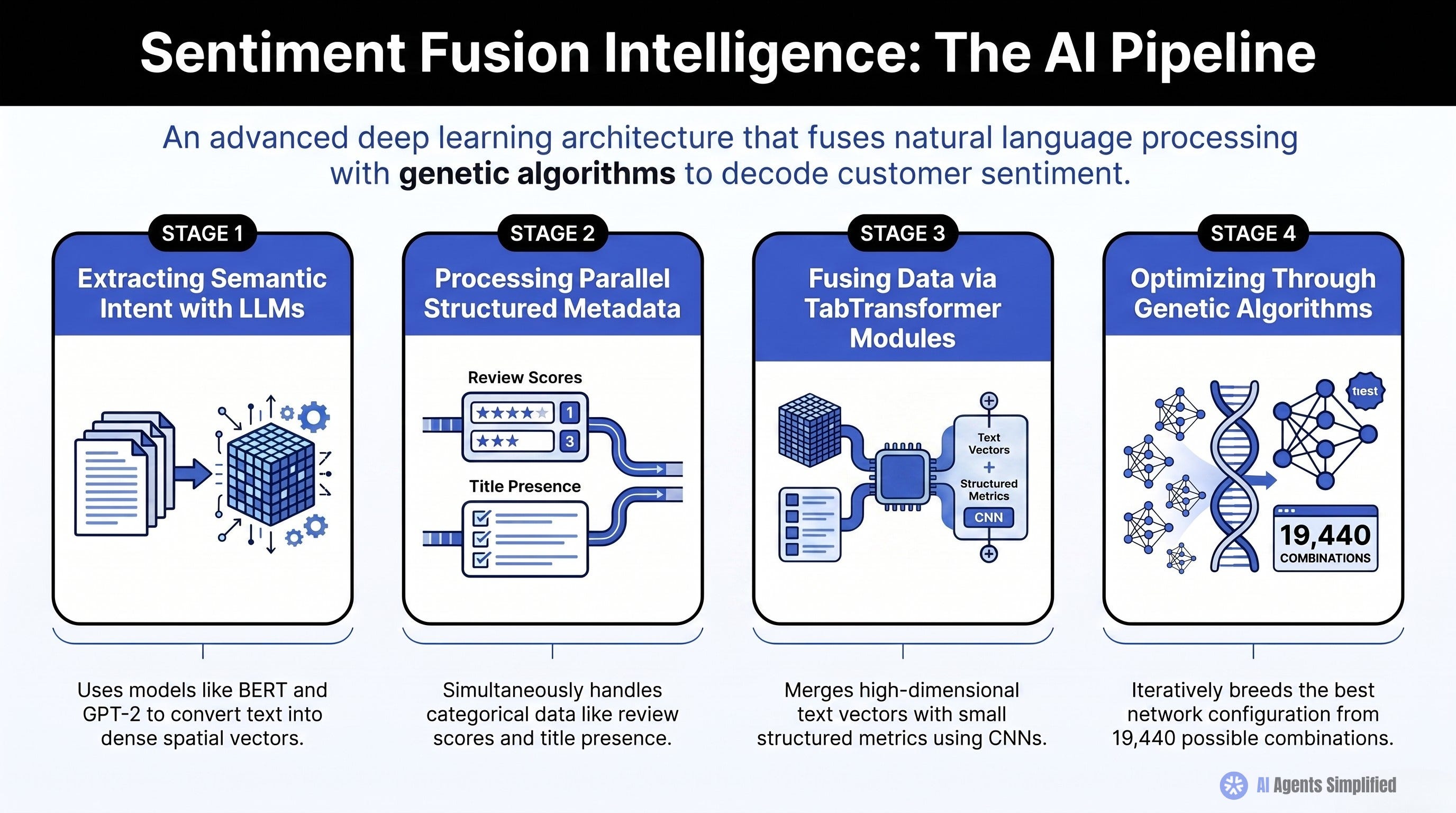
To move past these shallow analytics, the new research introduces an advanced deep learning architecture that reads the actual natural language text your customers leave in their feedback. Instead of waiting for lagging financial reports, the model converts unstructured text into actionable intelligence through a multi-stage pipeline:
Transformer Embedding Branches: The pipeline processes text using state-of-the-art Large Language Models, specifically BERT, RoBERTa, ALBERT, GPT-2, and Qwen 1.5-0.5B—to extract deep semantic intent and convert natural language into dense spatial vectors.
Parallel Structured Processing: It provisions an isolated branch to process structured categorical metadata simultaneously, specifically handling Review Scores and a binary flag tracking whether the user left a written title.
Intelligent Data Fusion with TabTransformer: The extracted text token embeddings and tabular metadata are fused using a TabTransformer module coupled with Convolutional Neural Networks (CNNs). This ensures massive, high-dimensional text vectors do not completely eclipse critical, small structured metrics (like title presence).
Evolutionary Calibration (Genetic Algorithm): Rather than performing an arbitrary hyperparameter search, the authors route the entire network topology through a Genetic Algorithm (GA). Operating over 50 generations with a population of chromosomes, the GA iteratively breeds configurations, exploring a search space of 19,440 possible combinations automatically.
To see if this deep learning approach was actually worth the engineering effort, the researchers ran an ablation study to see what happens when you strip the AI away. Here is what they found out:
10 AI Stocks to Lead the Next Decade

AI is fueling the Fourth Industrial Revolution – and these 10 stocks are front and center.
One of them makes $40K accelerator chips with a full-stack platform that all but guarantees wide adoption.
Another leads warehouse automation, with a $23B backlog – including all 47 distribution centers of a top U.S. retailer – plus a JV to lease robots to mid-market operators.
From core infrastructure to automation leaders, these companies and other leaders are all in The 10 Best AI Stocks to Own in 2026.
Free today. Not forever!
❤️ The best way to keep our mission going - at zero cost to you - is by checking out this free guide from our sponsor.
What the Results Teach Us
The optimized AI model proved incredibly accurate, correctly predicting customer loyalty over 92% of the time. But the real gold for product builders lies in understanding what data actually moves the needle:
Words Speak Louder Than Stars: When the system is forced to evaluate customer loyalty without reading the actual written review text, predictive accuracy collapses by nearly 37%. This proves that simple numerical ratings hide the true qualitative health of the user experience.
The “Subject Line” Clue: Simply checking whether a customer bothered to leave a written title or subject line provides a massive intent signal. Highly retained, loyal users are over 11 times more likely to include a written review title compared to churning or disengaged users.
Skipping the Star Rating: Remarkably, the AI system worked just as well when it had to “guess” the sentiment from open-ended natural language text as it did when given explicit, numerical star ratings. This is a game-changer for community forums, social media comments, or early MVPs where users do not leave formal ratings.
Stripping the Black Box with Explainable AI (XAI)
Deep learning models are notoriously difficult to trust in production due to their opaque, black-box nature. If an automated system flags a user as an attrition risk, product and engineering teams need to know exactly why.
To resolve this, the authors integrated SHAP values (SHapley Additive exPlanations), a game-theoretic approach developed by authors such as Mosca et al. (2022) that assigns an explicit importance attribution to every single token (word) within a raw review:
Token-Level Attribution: Local explanations generate force plots indicating which specific words push an agent’s prediction toward retention (e.g., “excellent”, “fast” visualized with positive force) versus words driving the prediction toward churn (e.g., “delay”, “waiting” visualized with negative force).
Global Vocabulary Mapping: Aggregating SHAP values across the entire 58,000+ user dataset maps overarching vocabulary triggers, showing that terms like “reliable” strictly shape positive boundaries, while terms like “unfortunately” aggressively drive negative boundaries.
If your technical pipeline relies only on lagging financial numbers, you only find out your AI agent has a bad UX when it is too late to save the user. Integrating an NLP-driven intent loop directly into your backend architecture changes the paradigm entirely, giving you the power to pick up on micro-signals of churn and intervene proactively.
Let’s Collaborate
As for myself, I’m Arian, Product Manager and writer at AI Agents Simplified. I absolutely love geeking out over the intersection of product management and e-commerce, supercharged by deep learning and AI.
If you’re an engineer, founder, or growth operator working on similar projects and want to bounce ideas around, or if you are interested in collaborating on future deep dives, let’s connect. Shoot us a message or email, I read and reply to every single one.
Resources
Authors: Pedram Kazemi Esfe, Fakhroddin Noorbehbahani
Title: Behavioral Loyalty Prediction from Customer Reviews in E-Commerce: A Deep Learning and Explainable AI Approach
Link: Behavioral Loyalty Prediction from Customer Reviews in E-Commerce
Journal: Journal of Computing and Security (JCS), http://www.jcomsec.org
Publication Details: Online published 21 June 2026; Volume 13, Number 1, Spring 2026, pp. 35-57