

The Biggest AI Failures Start With Tiny Mistakes
What a neural network attack reveals about building more resilient AI systems.


Welcome to the 63rd issue of AI Agents Simplified 🍻
This issue is brought to you by Novu Connect

The Biggest AI Failures Start With Tiny Mistakes
A cybersecurity paper that completely changed how I think about building reliable AI systems.
If I told you that changing just a handful of bits inside an AI model could make it almost useless, you would probably assume the model was poorly designed.
That was exactly my first thought.
Modern AI systems contain millions, and sometimes billions, of parameters. We constantly hear about larger models, longer context windows, and better benchmark scores. Intuitively, it feels like systems this large should also be incredibly resilient. After all, how much damage could a few tiny changes really cause?
This week, I read the research paper “Bit-Flip Attack: Crushing Neural Network with Progressive Bit Search“. At first glance, it looked like another cybersecurity paper describing a new way to attack neural networks. But after finishing it, I realized the paper wasn’t really about attacks.
It was about something much bigger.
It was about how complex AI systems fail.
Bigger Doesn’t Always Mean Stronger
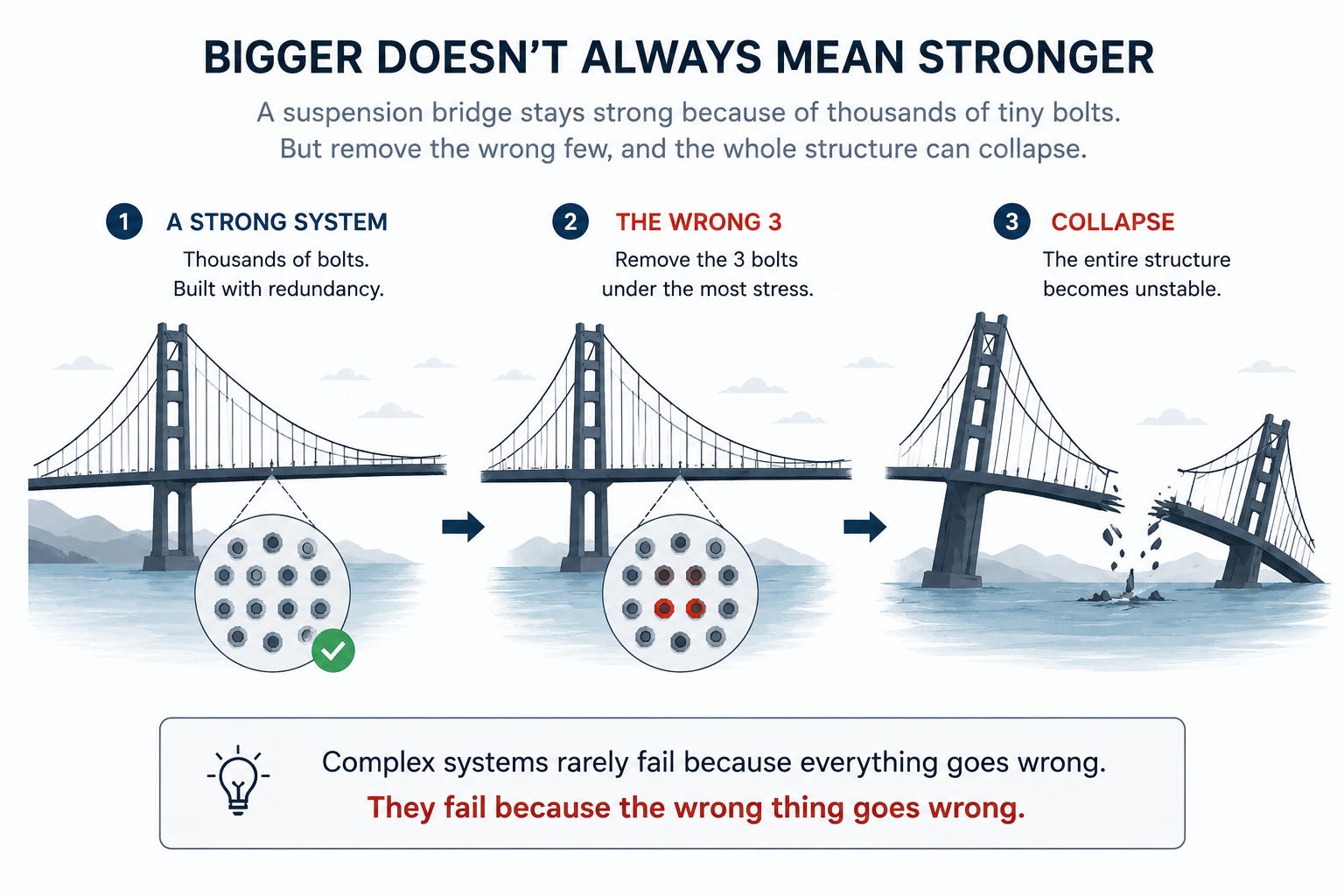
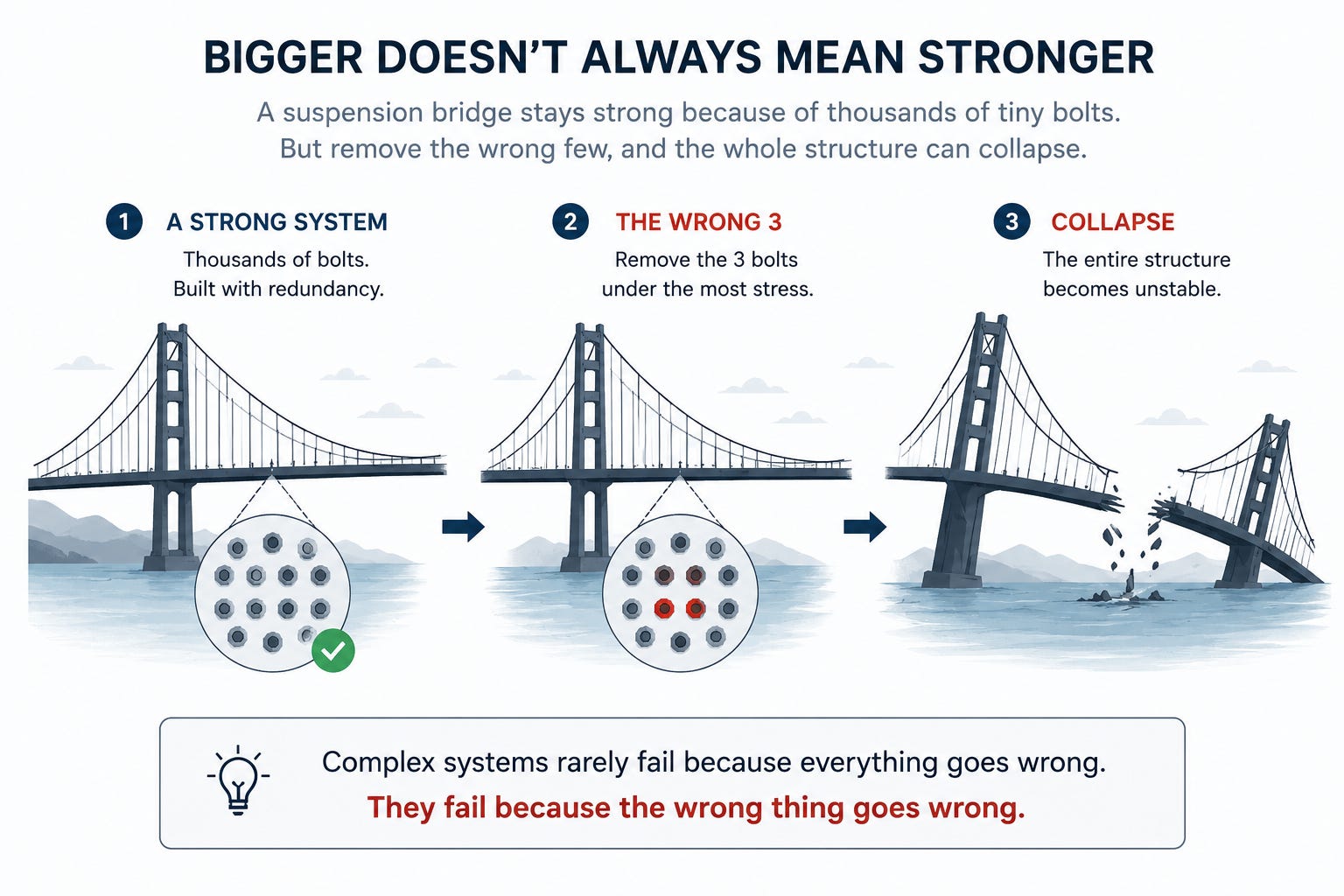
Imagine you’re standing beneath a suspension bridge.
The bridge is held together by thousands of steel cables, bolts, and support beams. If someone randomly removed ten bolts from different parts of the structure, chances are nothing would happen. The bridge was designed with redundancy, so a few random failures aren’t enough to bring it down.
Now imagine an engineer who knows that bridge perfectly.
Instead of removing ten random bolts, they remove the three carrying the highest amount of stress.
Suddenly, the entire structure becomes unstable.
The bridge didn’t collapse because many things went wrong.
It collapsed because the wrong thing went wrong.
That analogy stayed with me throughout the paper.
The researchers demonstrated that they didn’t need to corrupt an entire neural network to make it fail. Instead, they identified an extremely small number of carefully selected bits inside the model’s stored weights. By changing only those critical locations, they dramatically reduced the model’s performance. Random changes had little impact, but targeted ones completely changed the outcome.
The lesson wasn’t simply that AI models can be attacked.
The lesson was that complex systems often have hidden weak points.
Stop Rebuilding Integrations
Bring Your Claude Agents to Any Channel in Minutes

If your Claude agent is trapped inside your app, it’s time to move the conversation to where your customers actually live. Without the headache of maintaining custom infrastructure.
Novu Connect is the new standard in Agent Communication Infrastructure (ACI). It bridges the gap between your AI agents and any messaging platform, including Slack, Teams, WhatsApp, and email. You don’t need to spend weeks building pipelines; just pick a template, connect your tools, and you’re live in under 2 minutes.
No infrastructure to babysit, no custom plumbing to rebuild. Just immediate, two-way conversations with your customers.
Join the challenge: deploy your agent in under 2 minutes and unlock a free month of our Pro tier.
Complexity Creates Fragility
As AI systems become more capable, they also become more interconnected.
Today’s AI applications are no longer just models. They combine retrieval pipelines (RAG), memory systems, tool calling, Model Context Protocol (MCP), external APIs, planning modules, databases, browser automation, and dozens of moving parts working together.
That complexity is what makes modern AI so powerful.
It’s also what makes it difficult to reason about.
Most components inside a system are surprisingly forgiving. If something small goes wrong, the application usually continues working. But every complex system also contains a handful of hidden dependencies where a tiny failure can quietly propagate through everything else.
Reading this paper made me realize that the size of a system tells us very little about its resilience.
Sometimes the most dangerous weakness isn’t obvious.
Sometimes it’s hidden inside one small component that nobody thinks to question.
Why This Matters For AI Agents
I think this idea becomes even more important as we build increasingly autonomous AI agents.
When we evaluate agents today, we usually focus on capability. We ask whether they can solve harder problems, write better code, reason more effectively, or complete longer workflows.
Those are important questions.
But I think another question is becoming just as important:
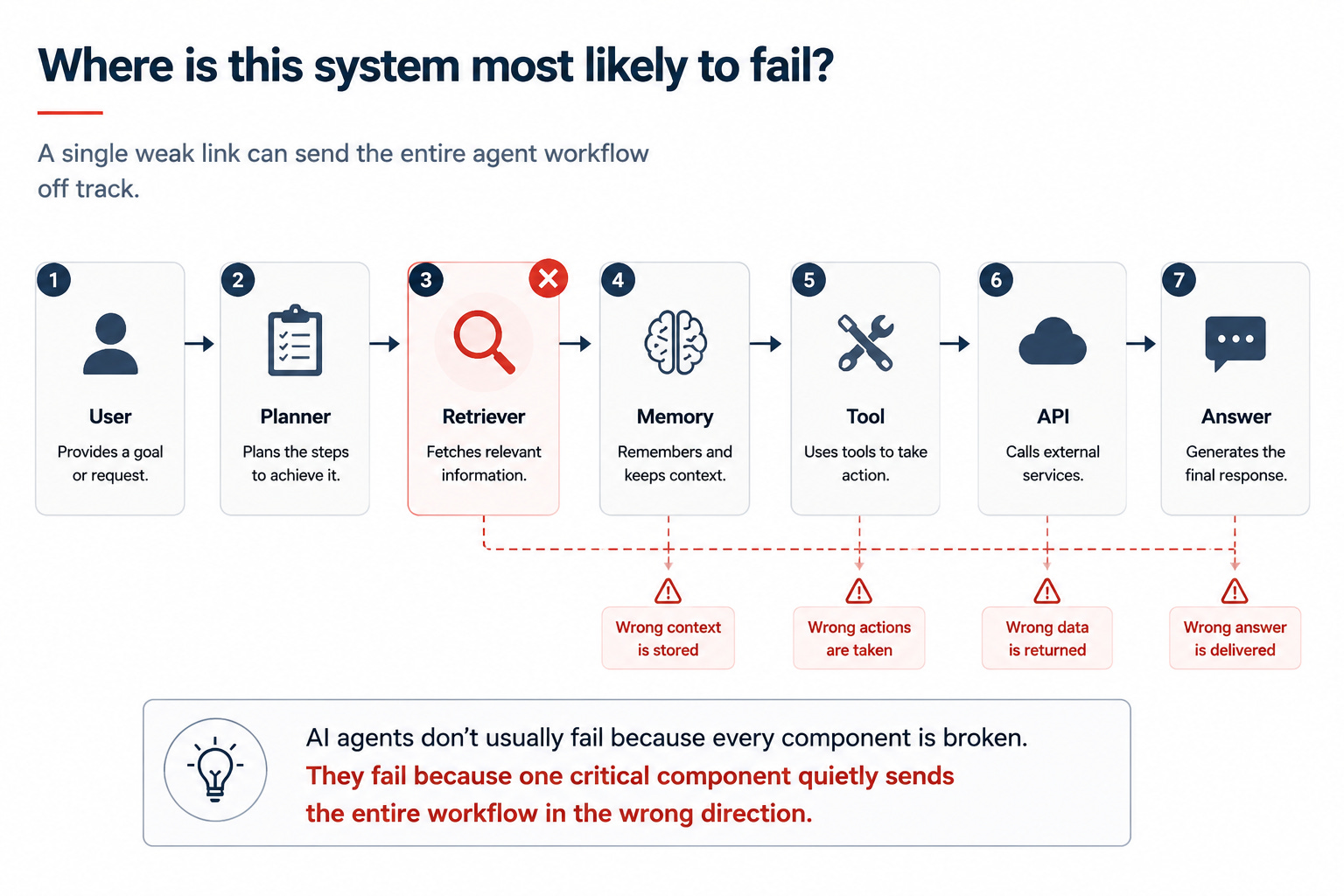
Where is this system most likely to fail?
A single incorrect retrieval result can influence every decision that follows. One faulty tool call can trigger an entire chain of unnecessary actions. A small mistake in memory can quietly change an agent’s behavior for hours without anyone noticing.
The problem isn’t that AI systems make mistakes.
The problem is that some mistakes travel much further than others.
As our systems become larger, identifying those critical failure points becomes just as important as improving the models themselves.
My Take
One sentence from this paper stayed with me long after I finished reading it, not because the authors wrote it explicitly, but because it emerged from their results.
Complex systems rarely fail because everything goes wrong. They fail because one important thing goes wrong.
I think that’s a lesson we’ll hear much more often over the next few years.
As AI moves from demos into production, reliability becomes just as valuable as intelligence. The companies building the next generation of AI products won’t succeed only because they have the smartest models. They’ll succeed because they’ve designed systems that can detect small failures, contain them, and recover before they become expensive.
Because in the end, the biggest AI failures rarely begin with something dramatic.
They begin with something so small that nobody noticed it, until it was too late.
A Hands-On Workshop for the Next Generation of Engineers
10 Essential AI Agents Every Engineer Must Build

A hands-on, build-along workshop where you build and run 10 production-inspired AI agents across finance, healthcare, and education. Walk away with a complete GitHub repo and implementations for OpenAI, Claude, Gemini, and local models.
🗓️ September 12th · 11:00 AM EDT onwards
Use code AGENTS50 for 50% off the early bird price. First 10 sign-ups only.
📖 Inspired By
This issue was inspired by the paper:
Bit-Flip Attack: Crushing Neural Network with Progressive Bit Search
Authors: Adnan Siraj Rakin, Zhezhi He, and Deliang Fan
Read the paper: https://arxiv.org/abs/1903.12269
🤝 Let’s Collaborate
Hey, I’m Arian, Product Manager and Partnership Manager at AI Agents Simplified.
If you’re building AI products, working on AI agents, or exploring partnerships in the AI ecosystem, I’d love to connect. Feel free to reach out through my LinkedIn or email. I’m always happy to discuss ideas, collaborations, and the future of AI.