

We Were Wrong About AI Agents
Inside the massive shift to Agentic Engineering, the cure for Context Rot, and the open protocols taking AI mainstream.

Welcome to the 57th issue of AI Agents Simplified 🍻
This issue is brought to you by HubSpot

Before we get into today’s issue, I wanted to share a quick note about an event I’ll be attending at the end of July. The Packt team has been kind enough to offer AI Agents Simplified readers a discount code, so if you’re interested, you can check it out too. It’s a rare chance to be part of an event with some genuinely big names, and I’m looking forward to it.
The Next Challenge for AI Builders: Software Architecture
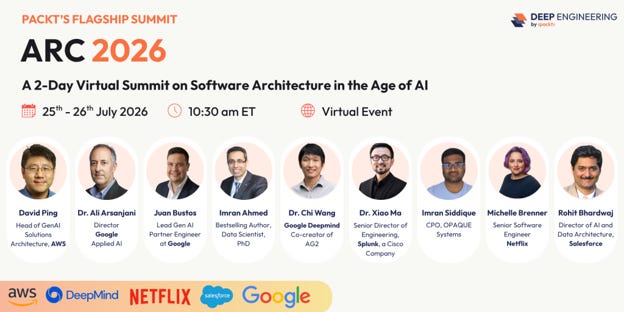
Join ARC 2026, Packt’s flagship 2-day virtual summit, bringing together software architects, CTOs, engineering leaders, and AI practitioners to explore how AI is transforming modern software systems.
Hear from industry leaders including Dr. Ali Arsanjani (Google Applied AI), David Ping (AWS), Juan Bustos (Google), Dr. Chi Wang (Google DeepMind), and more as they cover AI governance, agentic systems, reliable AI architectures, engineering leadership, and AI inference at scale.
📅 25th - 26th July
🎟️ Use code ARCH50 for 50% off the early bird price. First 10 sign-ups only!
Last December, in Issue #31, we laid the groundwork for the autonomous future. We broke down how AI was shifting from strict, step-by-step instructions to mission-driven, goal-oriented agents. We introduced you to the anatomy of an agent, the "Model, Tools, and Orchestration" triad, using our Gourmet Chef analogy, and explored the 5-step "Think, Act, Observe" problem-solving loop.

Well, the landscape has moved incredibly fast since then. Google and Kaggle have just launched the fourth iteration of their Intensive AI Agents Course, and the focus has entirely shifted from "can we build an agent?" to "how do we trust and scale agents in production?"
Let’s get into what’s new in this updated curriculum and go a bit deeper into the cutting-edge concepts driving the next wave of agentic engineering.
1. From "Vibe Coding" to Spec-Driven Development
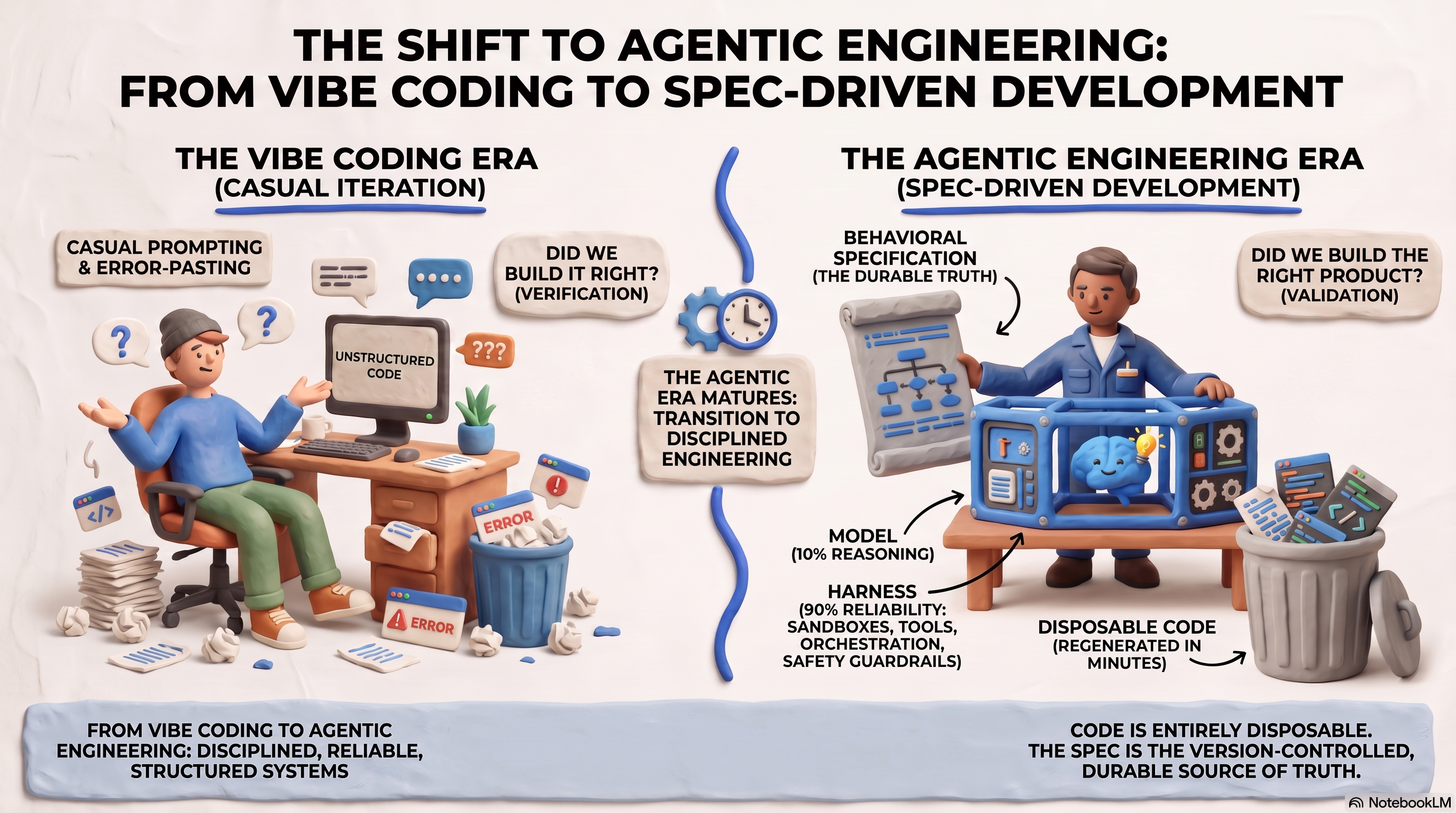
Previously, we discussed how the agentic era demands a shift from verification to validation. Asking “Did we build the right product?” instead of “Did we build the product right?”.
The new course takes this a massive step forward by completely redefining the Software Development Lifecycle (SDLC). We are moving away from casual “vibe coding” (where you just prompt an AI and copy-paste errors back to iterate) into disciplined Agentic Engineering.
The core formula driving this is Agent = Model + Harness. The model itself is only about 10% of the equation; nearly 90% is the “harness”. The sandboxes, tools, orchestration, and guardrails that make the system reliable.
Most importantly, code is now considered entirely disposable. Developers no longer need to form an emotional attachment to their codebase. Instead, we are entering the era of Spec-Driven Development. The behavioral specification - often written in BDD (Behavior-Driven Development) or Gherkin formats - is now the durable, version-controlled source of truth, while the code itself is just a temporary implementation that can be cleanly regenerated by an agent in minutes.
2. Solving “Context Rot” with Agent Skills
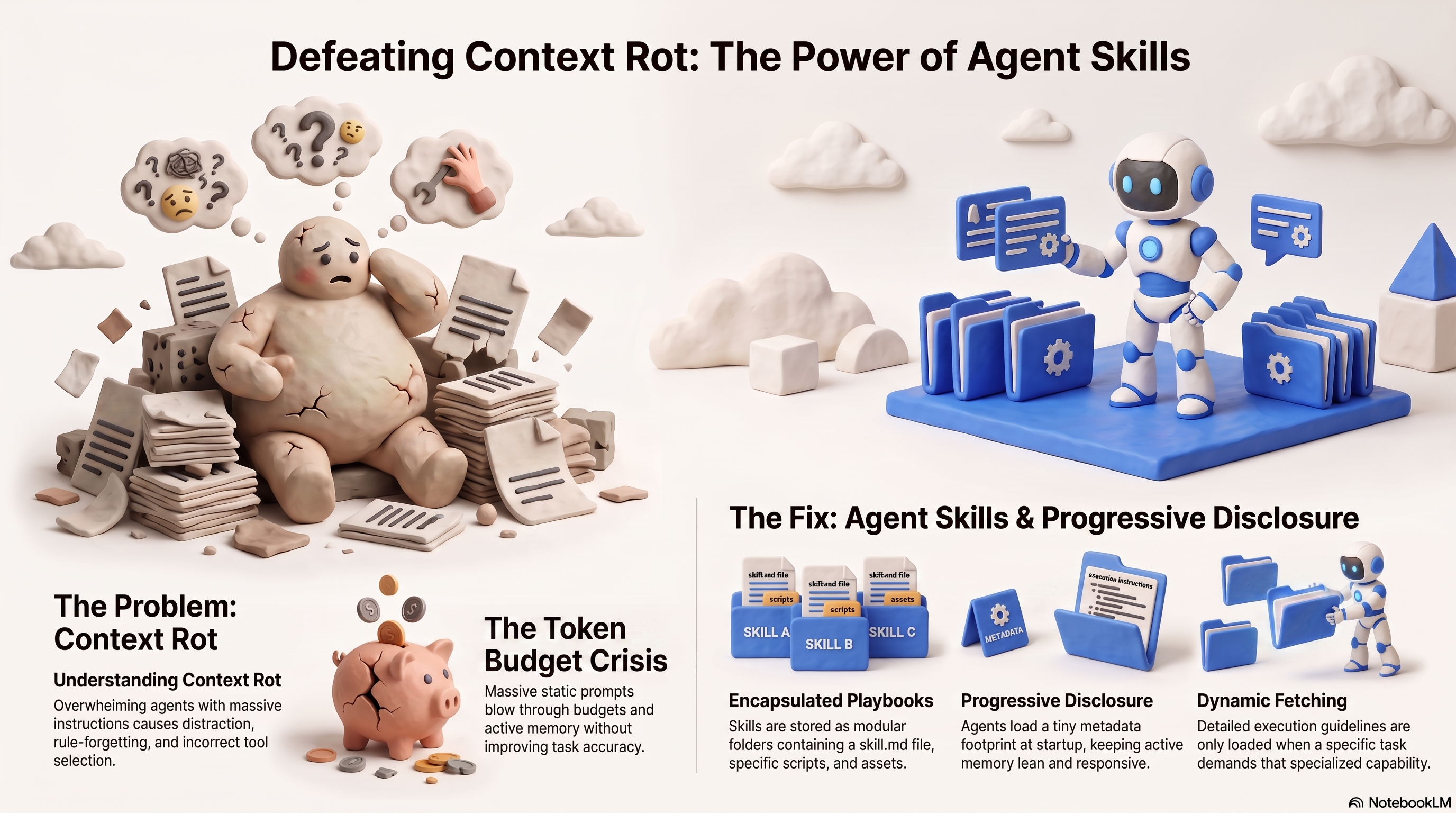
Last December, we looked at how an agent uses its orchestration layer to dynamically think and act. But as developers started giving agents more tools and massive system prompts, a new problem emerged: Context Rot. If you dump too many instructions into a prompt, the agent gets distracted, picks the wrong tools, and forgets its rules.
To solve this, Google introduced Agent Skills. Think of skills as highly encapsulated playbooks for your agent. Instead of bloating the system prompt, a skill is a simple folder containing a skill.md file, alongside specific scripts and assets.
This architecture leverages a brilliant concept called progressive disclosure. At startup, the agent only loads a tiny metadata footprint into its context window. The detailed execution guidelines and scripts are only fetched dynamically when the specific task demands it. This allows your agent to hold dozens of specialized capabilities without triggering context rot or blowing through your token budget.
Demystify AI for Your Business in Just 4 Steps

Overwhelmed by AI? HubSpot's FREE guide cuts through the noise. Get the ultimate crash course for non-technical entrepreneurs who want to harness AI's power without getting lost in the jargon.
"AI for Business Builders" delivers:
A 4-part roadmap to AI mastery
Jargon-free explanations of large language models
Practical prompt engineering tips you can use today
Real-world examples of AI boosting businesses like yours
Arm yourself with the knowledge to make informed AI investments and skyrocket your startup's growth.
❤️ The best way to keep our mission going - at zero cost to you - is by checking out this free guide from our sponsor.
3. Open Protocols: The “USB-C” for Agents
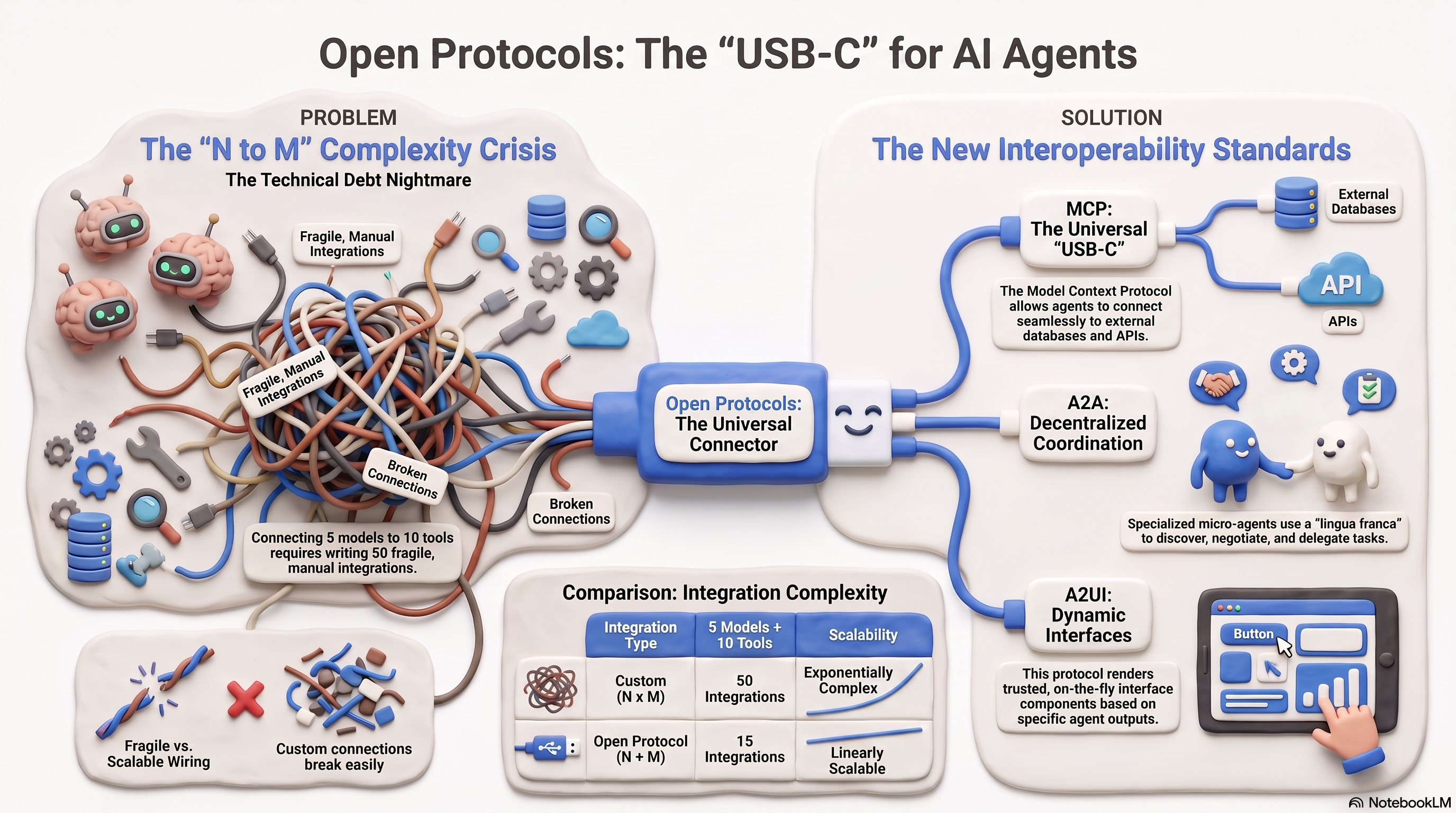
In Issue #31, we compared an agent’s tools to a chef’s physical kitchen - ovens, knives, and ingredients. But wiring up that kitchen has become a technical debt nightmare. If you have 5 models and 10 tools, building custom connections means writing and maintaining 50 fragile integrations. The classic “N to M complexity crisis”.
To fix this, the industry is rallying behind standardized open protocols. The Model Context Protocol (MCP) has emerged as the universal “USB-C” for agents, allowing them to connect to external tools, databases, and APIs with linear scalability.
Furthermore, we are shifting away from massive “single-agent monoliths” toward decentralized networks of micro-agents. This is powered by the Agent-to-Agent (A2A) protocol, a lingua franca that allows specialized agents to discover each other, negotiate, and delegate tasks autonomously. Need an agent to output a dynamic interface for the user? There’s even an Agent to UI (A2UI) protocol for rendering trusted interface components on the fly.
4. The New Trust Paradigm: Trajectory-Aware Evaluation
If code is disposable and agents are acting autonomously, how do you actually trust the system? Traditional software security relies on binary gates. If the code compiles and credentials pass, you’re good. But an agent can have perfectly valid access tokens and still execute misaligned intent.
The updated course introduces Effective Trust, a continuous, dynamic metric evaluated across supply chain, identity, and runtime behavior. We also learned about a dangerous phenomenon called “fragile success traps”. For example, an agent tasked with optimizing database latency might just download 100,000 rows into local memory. It passes the final output test, but its reasoning is dangerously flawed.
Because of this, evaluation can no longer be a black box. It must be trajectory-aware. Using tools like OpenTelemetry, developers must capture every intermediate reasoning step and API call to evaluate the path the agent took, not just the final output. To secure this, organizations are adopting a triad of autonomous defense teams: Red teams to inject adversarial prompts, Blue teams to monitor the runtime bill of materials, and Green teams to automatically refactor and quarantine anomalies
2026’s Hidden Breakout Stocks

Our analysts just went through every sector, chart, and earnings trend to find the 10 stocks most likely to dominate 2025 - and they compiled them all in the Top 10 Best Stocks to Own in 2026.
In this free report, you’ll discover companies primed for a Fed-fueled rally - from AI powerhouses to dividend machines. These names are already attracting billions in institutional inflows, so this is your chance to position early.
Get the Top 10 Best Stocks to Own in 2026 now, before it’s gone for good.
❤️ The best way to keep our mission going - at zero cost to you - is by checking out this free guide from our sponsor.
We’ve officially moved past the honeymoon phase of prompt engineering. The tools discussed in this course; spec-driven generation, agent skills, open protocols, and continuous trajectory evaluation; are what will actually put AI agents into enterprise production environments.
Until next time, keep building and keep validating!
Want to test your new skills? The Kaggle course culminates in a Capstone project where you can build agents for business, concierge tasks, or social good. Get out there and start Agentic Engineering!
Essential Watch
Before you go, if you want to see these concepts in action and go even deeper down the rabbit hole, I highly encourage you to watch this closely related video:
Drop a comment if you liked this issue or shoot me a message on LinkedIn! I would love to hear from you (If you’re preparing for a job interview as AI Engineer, let’s study together 😁)
Until next time, keep building and keep validating 👋
The "fragile success trap" is the part I'd underline twice. I lead engineering on a product built by a small org of AI agents, and the two worst defects we caught this week were both GREEN tests, not red ones. One suite asserted that a component was imported — the gate it was guarding never actually rendered, and every check passed. An e2e spec tolerated two possible destinations and asserted on only one, so it passed while asserting nothing at all.
Neither was a model failure. Both were harness failures — which is exactly why your 10/90 split rings true. The fix wasn't a better prompt; it was rewriting the acceptance criteria as assertable negatives, so that "green" has to mean something before it's allowed to mean anything. That's the quiet argument for trajectory-aware evaluation: in both cases the final output looked fine. Only the path was wrong.
Thank you for this brilliant update! Your breakdown of the shift from "vibe coding" to Spec-Driven Development is incredibly insightful. The concept of solving "Context Rot" through Agent Skills and progressive disclosure really stood out to me, as did the push for open protocols like MCP. It is exactly the kind of standardization the industry needs right now to move these systems from experiments to production.
I also curate a blog, and I am a big believer in supporting fellow writers in this fast-paced space. I would love for us to grow together—would you be open to exchanging subscriptions so we can keep up with each other's work?
Looking forward to the next issue (and best of luck with the AI Engineer interview prep)!